


Analytical ability helps people solve problems. Executive functions help them keep that thinking focused, flexible and directed toward the right goal.
A leader can understand the numbers and still rush a decision. An experienced specialist can recognize a problem yet persist with an approach that no longer works. A capable manager can struggle to prioritize when several demands arrive together.
Understanding these situations requires looking at how people control and apply their thinking.
This is where executive functions become business-critical. Executive functions are cognitive processes that help us maintain goals, manage information, resist distracting or automatic responses, and adapt when circumstances change. They support the deliberate thinking required in unfamiliar or demanding situations.
From a neuroscience perspective, these processes involve interacting brain networks, including prefrontal and parietal regions. The prefrontal cortex plays an important role in maintaining goals and rules that guide how information is processed and how we respond.
Understanding these situations requires looking at how people control and apply their thinking.
This is where executive functions become business-critical. Executive functions are cognitive processes that help us maintain goals, manage information, resist distracting or automatic responses, and adapt when circumstances change. They support the deliberate thinking required in unfamiliar or demanding situations.
From a neuroscience perspective, these processes involve interacting brain networks, including prefrontal and parietal regions. The prefrontal cortex plays an important role in maintaining goals and rules that guide how information is processed and how we respond.
Executive functions support analytical thinking itself
Following a complex argument requires holding earlier information in mind. Comparing alternatives requires keeping the decision criteria active. Revising a conclusion requires disengaging from an earlier interpretation.
Inhibitory control and cognitive flexibility support these activities. Reasoning and executive control overlap and are not separate brain compartments. Executive functions are basically our command center, helping us organize and sustain the thinking that a demanding problem requires.
Inhibitory control and cognitive flexibility support these activities. Reasoning and executive control overlap and are not separate brain compartments. Executive functions are basically our command center, helping us organize and sustain the thinking that a demanding problem requires.
“Executive functions are basically our command center, helping us organize and sustain the thinking that a demanding problem requires.”
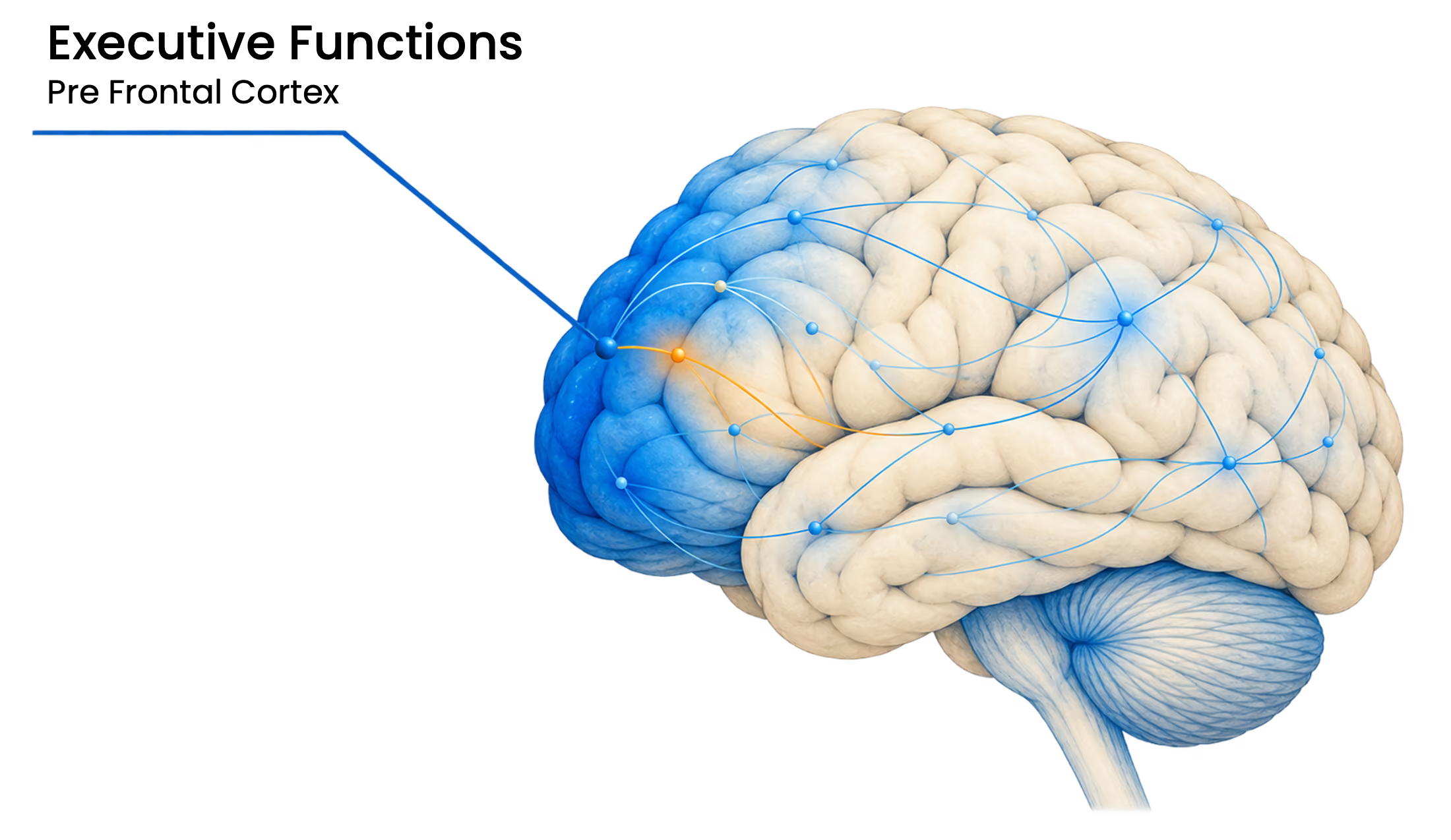
When we get stressed, the higher-order cognitive parts needs to take command of the more primitve parts of our brain, such as the reptile brain that can kick in anytime. Have you every though instinctly "no ofcourse not" when someone ask you something really private, alltough it's actually true, which than becomes obvious?
You are reaction with your emotions. Sometimes the executive functions helps you to control it. Sometimes you are just under too much pressure.
That connection becomes tangible in everyday business:
You are reaction with your emotions. Sometimes the executive functions helps you to control it. Sometimes you are just under too much pressure.
That connection becomes tangible in everyday business:
Business situation
Executive function involved
Why it matters
A commercial director evaluates a concession while considering margin, capacity and customer value.
Working memory: maintaining and updating relevant information.
Supports comparing options against several constraints without losing track of the decision criteria.
A leader is challenged on an investment recommendation.
Inhibitory control: managing an immediate response and filtering interference.
Helps create space to examine the objection before reacting defensively or dismissing it.
New evidence undermines the assumptions behind a growth plan.
Cognitive flexibility: changing perspective or approach.
Supports revising the analysis rather than repeatedly applying an outdated model.
A manager turns a transformation strategy into coordinated actions.
Planning: drawing on several executive processes to sequence steps and anticipate dependencies.
Helps translate a sound idea into workable priorities, resources and execution.
These examples illustrate cognitive demands, rather than suggesting that any single function determines a business outcome.
Pressure adds another dimension. A meta-analysis found that acute stress impaired working memory and cognitive flexibility on average, while effects on inhibition differed by the type assessed. The business implication is important: the conditions that demand careful, adaptable thinking can also make that thinking harder.
This makes executive functions relevant to both individual assessment and the environment in which people work.
Pressure adds another dimension. A meta-analysis found that acute stress impaired working memory and cognitive flexibility on average, while effects on inhibition differed by the type assessed. The business implication is important: the conditions that demand careful, adaptable thinking can also make that thinking harder.
This makes executive functions relevant to both individual assessment and the environment in which people work.
Three complementary perspectives on performance
Personality, analytical reasoning and executive functions answer different, connected questions:
Assessment area
Primary question
How it is assessed
Personality
What are the person’s typical behavioral tendencies and preferences?
Commonly through self-report questionnaires about characteristic behavior.
Analytical Reasoning
How effectively can the person identify relationships, evaluate information and solve problems?
Performance-based tasks with answers evaluated against defined criteria.
Executive Functions
How effectively can the person maintain goals, control responses and adjust thinking under specific demands?
Performance-based tasks involving rules, interference, planning or changing requirements.
These distinctions describe the focus of the assessments, not completely independent abilities.
A person may describe themselves as adaptable in a personality questionnaire. A reasoning task may show how accurately they solve a problem. An executive-function task can examine how they respond when a rule changes or a familiar response must be inhibited.
Together, these perspectives provide a richer basis for interpretation.
A person may describe themselves as adaptable in a personality questionnaire. A reasoning task may show how accurately they solve a problem. An executive-function task can examine how they respond when a rule changes or a familiar response must be inhibited.
Together, these perspectives provide a richer basis for interpretation.
Performance-based assessment adds a different kind of evidence.
In Cohr’s executive-function assessments, participants complete structured tasks rather than rate their own capabilities. Tower tasks examine planning; Color Word tasks involve interference control; Card Sorting tasks involve detecting and adapting to rules.
Results therefore reflect performance under defined conditions. They do not depend solely on how participants perceive or describe themselves.
This distinction matters scientifically. A review comparing executive-function tasks with rating measures found that they provided different kinds of information and should not be treated as interchangeable. That research concerned executive-function ratings, rather than personality questionnaires specifically, but reinforces the importance of distinguishing reported behavior from task performance.
Performance-based measures still require careful interpretation. They assess behavior during tasks, rather than directly recording brain activity or reproducing every demand of a working day.
Results therefore reflect performance under defined conditions. They do not depend solely on how participants perceive or describe themselves.
This distinction matters scientifically. A review comparing executive-function tasks with rating measures found that they provided different kinds of information and should not be treated as interchangeable. That research concerned executive-function ratings, rather than personality questionnaires specifically, but reinforces the importance of distinguishing reported behavior from task performance.
Performance-based measures still require careful interpretation. They assess behavior during tasks, rather than directly recording brain activity or reproducing every demand of a working day.
Are we examining what we expect people to do?
Businesses routinely ask for judgment, adaptability and strategic thinking. The opportunity is to examine the cognitive demands beneath these expectations more explicitly.
In selection, that means connecting assessment to the role’s actual challenges. In development, it means moving from broad feedback to specific situations: handling conflicting information, reconsidering assumptions or sequencing decisions. In work design, it means providing clear priorities and reducing unnecessary interruption.
At Cohr, executive-function assessment is a critical part of the, just like the excutive functions for our brain, with results interpeted in combination with analytical reasoning and personality.
The value lies in understanding how these different sources of evidence fit together and what they suggest about strengths, potential risks and development priorities.
In selection, that means connecting assessment to the role’s actual challenges. In development, it means moving from broad feedback to specific situations: handling conflicting information, reconsidering assumptions or sequencing decisions. In work design, it means providing clear priorities and reducing unnecessary interruption.
At Cohr, executive-function assessment is a critical part of the, just like the excutive functions for our brain, with results interpeted in combination with analytical reasoning and personality.
The value lies in understanding how these different sources of evidence fit together and what they suggest about strengths, potential risks and development priorities.
When the next critical decision arrives, analytical ability matters. But it means little if we cannot keep that analysis focused, challenge it and change direction when the evidence requires it.

References
Diamond, A. (2013). Executive functions. Annual Review of Psychology, 64, 135–168.
https://doi.org/10.1146/annurev-psych-113011-143750Friedman, N. P., & Miyake, A. (2017). Unity and diversity of executive functions: Individual differences as a window on cognitive structure. Cortex, 86, 186–204.
https://doi.org/10.1016/j.cortex.2016.04.023Miller, E. K., & Cohen, J. D. (2001). An integrative theory of prefrontal cortex function. Annual Review of Neuroscience, 24, 167–202.
https://doi.org/10.1146/annurev.neuro.24.1.167Shields, G. S., Sazma, M. A., & Yonelinas, A. P. (2016). The effects of acute stress on core executive functions: A meta-analysis and comparison with cortisol. Neuroscience & Biobehavioral Reviews, 68, 651–668.
https://doi.org/10.1016/j.neubiorev.2016.06.038Toplak, M. E., West, R. F., & Stanovich, K. E. (2013). Practitioner review: Do performance-based measures and ratings of executive function assess the same construct? Journal of Child Psychology and Psychiatry, 54(2), 131–143.
https://doi.org/10.1111/jcpp.12001